Two civilizations. Two completely different philosophies about what a number actually is. That gap is why you can type your name into two different numerology apps and get two wildly different results, and why one of those results actually means something.
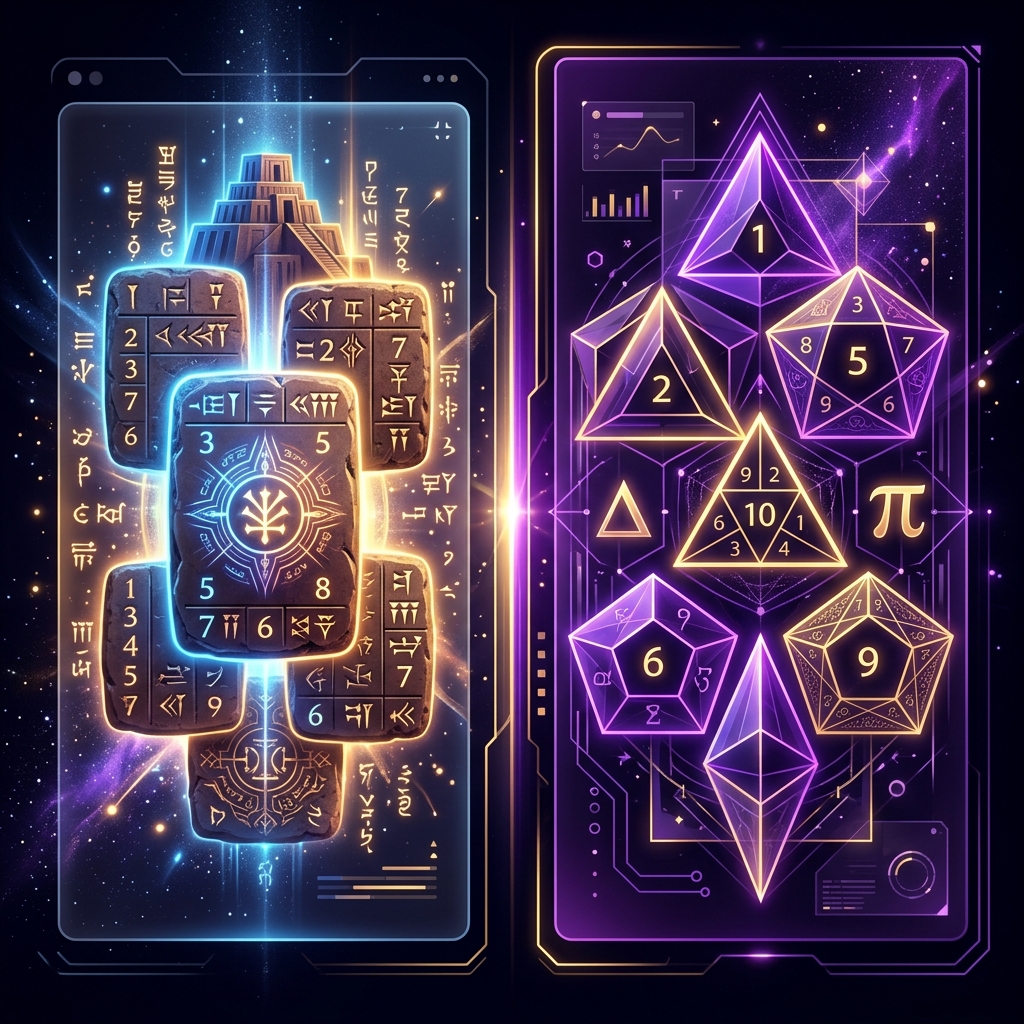
The Chaldean system comes from ancient Babylon, the civilization that also gave us the zodiac, the seven-day week, and some of the oldest astronomical records on the planet. The Chaldeans, a priestly class living in southern Mesopotamia around 600 BCE, did not invent numerology as a party trick. For them, numbers were vibrational frequencies embedded in the fabric of creation. Each number from 1 to 8 corresponded to one of the seven visible celestial bodies plus the Earth, and those correspondences were treated as cosmic law, not suggestion.
The Pythagorean system, built by Pythagoras of Samos around 500 BCE, takes a completely different angle. Pythagoras believed the universe was built on mathematical ratios and harmonic intervals, which is the same insight that gave us the music theory of the Western world. His school in Croton, southern Italy, assigned numbers 1 through 9 to the 26 letters of the Greek alphabet in strict sequential order. A goes to 1, B goes to 2, and so on. The logic is elegant, systematic, and easy to teach. It also makes a core assumption the Chaldeans would have rejected outright: that every letter has equal standing in the cosmic order.
Think of it this way. The Pythagorean system is the public school curriculum, structured, consistent, and built for scale. The Chaldean system is the guru's private notebook, earned through thousands of years of observation, where the assignments are based on how each letter actually sounds and vibrates when spoken aloud, not where it falls in the alphabet. Both have value. They are not interchangeable.
A trivia point worth remembering: Pythagoras himself studied in Egypt and Babylon for years before founding his own school. Some historians argue that what we call the Pythagorean system is actually a simplified adaptation of what he learned in the East, stripped of its more esoteric Chaldean roots so it could be taught to a broader audience. The original, it turns out, may have always been Chaldean.
This history matters because both systems are still in active use today, often without users knowing which one they are looking at. Most mainstream numerology apps, astrology websites, and pop culture content default to Pythagorean because it is simpler to code and easier to explain. That convenience has a cost, which this article gets into.
Get Your Free Janam Kundli Online
Generate your complete Vedic birth chart with D1, D9 Navamsha, Vimshottari Dasha, and Shadbala instantly.
Generate Free KundliThis is probably the most misunderstood detail in numerology, and the answer reveals the entire philosophical foundation of the Chaldean system.
In Chaldean numerology, the number 9 is considered sacred and set apart. It is the number of completion, the divine total, the number that contains all others. The Chaldeans believed 9 should never be assigned to a letter because doing so would mean reducing the sacred to the mundane. Nine belongs to God. Letters belong to humans. You do not mix them. This is not superstition. It is a deliberate cosmological design choice, the same logic that kept the number zero hidden from common use in ancient cultures for centuries because zero, like nine, pointed to something beyond the countable world.
In contrast, the Pythagorean system has no such reservation. It cycles 1 through 9 repeatedly across the alphabet: A=1, B=2 ... I=9, J=1, K=2, and so on. Clean, democratic, with no letters left out and no number treated as off-limits. The Pythagorean system treats 9 as just another digit in the cycle. The Chaldean system treats it as a category error to even try.
What this means practically is that the letter values for the same letter can differ significantly between systems. The letter S is an 1 in Chaldean and a 1 in Pythagorean as well in that specific case, but the letter H is a 5 in Chaldean and an 8 in Pythagorean. The letter I is a 1 in Chaldean and a 9 in Pythagorean. Stack those differences across a full name and you get results that diverge completely.
One common Instagram myth is that the Chaldean system simply has a typo or historical error, and that someone forgot to include 9. This is wrong. The omission is intentional, documented in classical Chaldean texts, and consistent across all historical versions of the system. The Chaldean numericists were not careless. They were making a theological statement about the nature of the number 9 that the Pythagorean school later chose to override.
Another subtle point: the Chaldean system does produce compound numbers (like 14, 28, or 37) before reducing them to a single root. The compound number itself is read for additional meaning before reduction. A 14, for instance, carries the energy of movement and risky independence before it collapses to a 5. Pythagorean numerology also uses compound numbers, but the tradition of reading them as standalone entities with specific character is far more developed in the Chaldean lineage.
Let us use a real example. We will calculate the Chaldean name number for the name ARJUN.
The Chaldean letter-value chart assigns: A=1, R=2, J=1, U=6, N=5. The chart itself is not sequential. It is based on phonetic vibration. Here is the full assignment for reference: A=1, B=2, C=3, D=4, E=5, F=8, G=3, H=5, I=1, J=1, K=2, L=3, M=4, N=5, O=7, P=8, Q=1, R=2, S=3, T=4, U=6, V=6, W=6, X=5, Y=1, Z=7.
For ARJUN: A(1) + R(2) + J(1) + U(6) + N(5) = 15. The compound number is 15. In Chaldean tradition, 15 is a number associated with magnetism, eloquence, and a powerful ability to persuade. Before reducing it, sit with 15 for a moment. Then reduce: 1 + 5 = 6. The root name number is 6, ruled by Venus, associated with harmony, responsibility, and creative beauty.
Step-by-step for clarity. Write the full name in capital letters. Look up each letter's value in the Chaldean chart. Add all values together to get the compound sum. Note the compound number and its traditional meaning. Reduce to a single digit by adding the two digits of the compound. That single digit is your Chaldean name number.
If your name has more than one word, calculate each word separately, note the compound for each, then add the totals together and reduce again. For a name like PRIYA SHARMA: P(8)+R(2)+I(1)+Y(1)+A(1) = 13, and S(3)+H(5)+A(1)+R(2)+M(4)+A(1) = 16. Total = 13 + 16 = 29. Compound 29. Reduce: 2 + 9 = 11. Reduce again: 1 + 1 = 2. Chaldean name number is 2, but 11 is a master number in many traditions and should be noted before further reduction.
One thing most tutorials skip: use the name you actually go by, not necessarily your full legal name. Chaldean numerology treats the name as a vibration you are actively broadcasting. If your parents named you Raghavendra but everyone calls you Raghu since age five, Raghu is the active vibration in your life. Calculate both, but weight the everyday name more heavily in your reading.
The Pythagorean system is sequential and easy to memorize. A=1, B=2, C=3, D=4, E=5, F=6, G=7, H=8, I=9, then it cycles: J=1, K=2, L=3, M=4, N=5, O=6, P=7, Q=8, R=9, and cycles again: S=1, T=2, U=3, V=4, W=5, X=6, Y=7, Z=8.
Using the same name ARJUN: A(1)+R(9)+J(1)+U(3)+N(5) = 19. Reduce: 1+9 = 10. Reduce again: 1+0 = 1. Pythagorean name number for ARJUN is 1. Compare that to the Chaldean result of 6 and you can immediately see these are not minor rounding differences. They point to completely different archetypal energies. One system says Arjun is Venus-ruled, relational, and creatively oriented. The other says he is Sun-ruled, independent, and pioneering. Both cannot be correct as a primary reading.
The Pythagorean system also has specific sub-calculations that are well-developed in its tradition. The Expression Number uses the full birth name with all letters. The Soul Urge (or Heart's Desire) uses only the vowels. The Personality Number uses only the consonants. These three together paint a layered portrait of who you appear to be versus what you actually want versus what your name projects to the world. These subdivisions are taught more extensively in Pythagorean schools than in Chaldean ones.
For PRIYA SHARMA in Pythagorean: P(7)+R(9)+I(9)+Y(7)+A(1) = 33, and S(1)+H(8)+A(1)+R(9)+M(4)+A(1) = 24. Total = 57. Reduce: 5+7 = 12. Reduce: 1+2 = 3. Pythagorean name number is 3. Again, compare to the Chaldean result of 2. Completely different energies.
The calculation itself in Pythagorean is faster, which is why it became the system that apps default to. You do not need a special lookup chart. You just count where the letter falls in the alphabet and cycle through 1 to 9. For general introduction to numerology, it works as a gateway. The problem arrives when people treat the gateway as the destination.
The core argument is phonetic accuracy. The Chaldean system assigned number values based on the acoustic vibration of letters in ancient Semitic languages, primarily Aramaic and Hebrew. The premise is that the sound a letter makes when spoken carries a specific energetic frequency, and that frequency, not the letter's position in a sequence, is what matters numerologically.
Think of it like tuning a musical instrument. Pythagorean is like assigning notes to keys based on keyboard position. Key 1 is A, key 2 is B. Chaldean is like assigning notes based on actual resonance frequency. The letter M has a sustained, grounding vibration when spoken. The letter S carries a hissing, kinetic energy. Those differences are built into the Chaldean chart and ignored by the Pythagorean one.
Practitioners who work with both systems over years consistently report that Chaldean name readings have higher hit rates for life events and personality accuracy. This is not peer-reviewed science. It is practitioner consensus built across decades. Names that show as highly auspicious in Chaldean but neutral in Pythagorean tend to behave like auspicious Chaldean names in real life, and vice versa. The observed match rate is why serious numerologists, including those trained in classical Indian Anka Shastra traditions, use Chaldean as the primary lens for name analysis.
There is also the matter of historical depth. The Chaldean system has been documented in use for over 2,600 years. It influenced Kabbalistic numerology, which influenced medieval European esoteric traditions, which influenced most of the serious Western numerological scholarship of the 20th century. Cheiro, one of the most well-documented Western numerologists of the early 1900s (whose celebrity client list included Mark Twain, Oscar Wilde, and European royalty), used exclusively the Chaldean system. His results were documented enough to be remarkable. He used Chaldean.
A popular myth on numerology TikTok says the Pythagorean system is more accurate because it was created by a mathematician and the Chaldean system was created by mystics. This is backwards on multiple levels. Pythagoras was as much a mystic as a mathematician. His school was a religious brotherhood. And the Chaldean priests who developed their system were also the foremost astronomers of their era. Precision and mysticism were not opposed in ancient scholarship. They were the same project.
Yes, and dismissing it entirely misses the point. The Pythagorean system is genuinely useful for certain calculations, just not the ones most people are using it for.
Where Pythagorean shines is in life path and personal year calculations using birth dates. Since those calculations involve numerals rather than letters, there is no letter-to-number conversion involved and therefore no divergence between systems. A Life Path Number calculated from a birth date is identical regardless of which system you use, because you are working directly with digits. The system differences only kick in when letters are involved.
Pythagorean is also the better entry point for teaching. Its sequential logic makes it easy to explain in a classroom or YouTube video without needing historical context. For someone brand new to numerology who wants to understand what a life path number is, how personal years cycle, or what the general numerological meaning of their birthday might be, Pythagorean works cleanly and accessibly. Start there, then graduate.
Some Western numerological lineages, particularly those developed in 20th century America, built entire structured frameworks around Pythagorean name analysis including the Expression Number, Karmic Debt Numbers, and Hidden Passions. These frameworks are internally consistent and have produced genuine insights for many practitioners. The results are real within that framework. The issue is not that Pythagorean is fake. The issue is that when two systems produce contradictory name readings, one needs to be treated as primary, and the weight of historical evidence points to Chaldean for that role.
The modern use case where Pythagorean remains genuinely competitive is rapid pattern screening. If you are a numerologist screening dozens of name options for a business or baby and want a quick first pass, Pythagorean is faster to compute mentally. Flag anything that looks problematic, then run those candidates through the Chaldean system for a final check. Use the right tool for the right job in the right order.
This comes up constantly, and the anxiety around it is understandable. You run your name in two calculators, you get a 6 and a 4, and suddenly you do not know whether you are Venus-blessed or carrying Rahu's weight.
The practical answer: treat Chaldean as your operative reading for the name's vibration. If your name is auspicious in Chaldean, that is the active signal. The Pythagorean result is secondary context, interesting to note, not a reason to panic or rename yourself.
Where it gets genuinely complicated is when the Chaldean reading of your name produces a number that your birth numbers (Driver and Conductor in Vedic numerology) conflict with. For example, if your birth date gives you a strong 1 energy (Sun-ruled, independent, leadership-oriented) but your Chaldean name number is 8 (Saturn-ruled, karmic, slow-burning), that is a real friction point worth addressing. The name you broadcast to the world does not align with your internal drive. You may find yourself attracting situations that feel like they are working against your natural energy rather than with it.
In such cases, numerologists typically look at a few options. A minor name adjustment, like going by a nickname or adding/removing an initial, can shift the Chaldean name value without requiring a legal name change. Even the name you use as your professional or social identity matters. Your LinkedIn display name is the vibration your professional network experiences. Your Instagram handle has a vibration. None of this is small.
One grounding truth: many people with apparent system-conflict names live perfectly functional, even remarkable, lives. The numbers describe tendencies, not fate. If your name creates some friction between systems, treat it as data. Understand the tension. Then decide whether a correction is worth pursuing based on the actual quality of your life results, not based on anxiety from a calculator.
The most grounded test of any name's vibration is observational. Run a 30-day experiment. For one month, introduce yourself exclusively with the name (or version of your name) whose Chaldean number you want to test. Note three things at the end of each week: the quality of new connections made, the ease or friction of professional conversations, and the general sense of momentum or drag in your life.
This is not placebo testing. Name vibration operates regardless of whether you believe in it. The number does not care about your skepticism. What you are testing is the actual experiential output of one vibrational signal versus another. Keep a short log. Five lines per day is enough. After 30 days, you will have enough data to know whether a name correction is worth pursuing.
A secondary practice: write your name in the way you most commonly sign it, and then calculate the Chaldean value of that specific written form. Some people sign their full name. Others sign initials. Others have a stylized version that abbreviates. Each written form is a vibrational broadcast you send out every time you sign a document, a contract, an email. That broadcast compounds over time. If your signature form gives an unfavorable Chaldean number, consider adjusting how you sign, even slightly.
Third practice: say your name out loud every morning for 21 days as part of a simple intention-setting ritual. Not as affirmation theater. Just as a way of consciously inhabiting the vibration you are broadcasting rather than running it on autopilot. Most people spend zero seconds thinking about what their name sounds like as a vibrational pattern. Twenty-one days of conscious attention to this creates a shift in how you carry the name, which changes how it lands when others hear it. The internal shift is real even before any external numerological correction is made.
Final check: if you are considering a name change for business or personal branding, always calculate the Chaldean value of the new name before committing. New business name, new website domain as a brand word, new artist name, new social media handle. Run the Chaldean check first. A lucky number on launch creates a different energetic runway than a difficult one. This takes two minutes and the information is free. There is no reason to skip it.