Everything in numerology operates in cycles of 9, and the Personal Year cycle is the most immediately practical application of that principle. Every nine years, you complete one full energetic revolution: from initiation (Year 1) through development, expansion, challenge, pivot, and ultimately to completion and release (Year 9), before beginning again. This is the 9-Year Epicycle, and it operates as precisely as a clock regardless of whether you are aware of it.
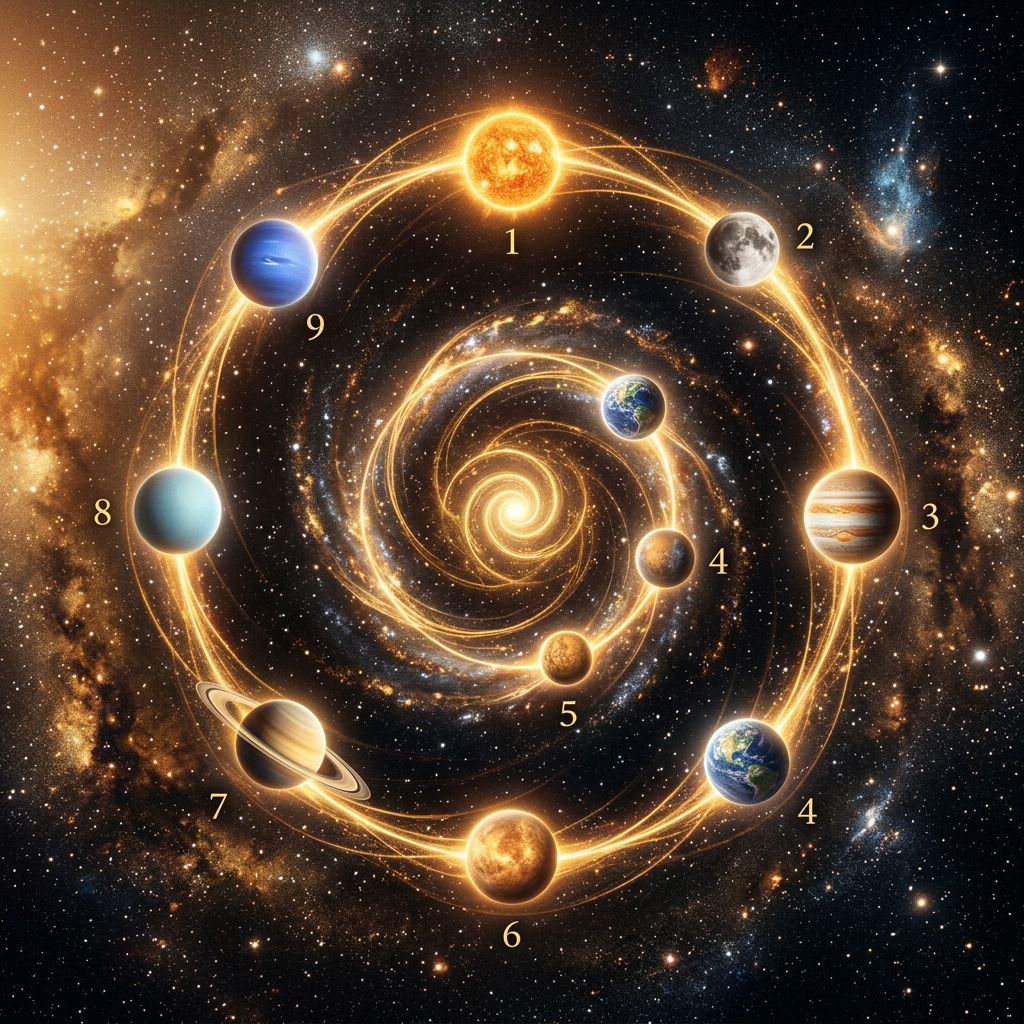
The weather forecast analogy is exact and not merely illustrative. You cannot force summer in January. You can wear extra layers, you can heat your home, you can travel south, but you cannot make January into July. Personal Year cycles work the same way. In a Year 7, the universe creates conditions favorable to introspection, solitude, and inner work. You can brute-force external activity in a Year 7, but the conditions for those efforts are not favorable and the results will reflect that. Understanding your cycle does not give you control over the weather. It gives you the intelligence to dress appropriately.
The concept of cyclical time is ancient across cultures. In Vedic cosmology, time itself is cyclical, structured in yugas and mahayugas of repeating evolutionary phases. In Chinese philosophy, the ten Heavenly Stems and twelve Earthly Branches create 60-year cycles of influence. The 9-Year Epicycle in numerology is a microcosmic expression of the same principle: recurring patterns of energetic quality that shape what is easy, what is difficult, and what is simply not yet time.
The practical power of the Personal Year system is not that it tells you what will happen. It tells you what energetic conditions you are working in, which helps you decide what to attempt and what to defer. Launching a business in Year 1 is planting in spring: the conditions support initiation. Launching a business in Year 9 is planting in late autumn: the ground is preparing for a different season and the new seed may struggle to take root before the conditions shift. You can still launch in Year 9. The cycle is a probability-shaper, not a prohibition.
Trivia: the number 9 holds a unique mathematical property that underlies the entire cycle's logic. Any number multiplied by 9 produces a result whose digits sum back to 9: 9x3=27, 2+7=9; 9x7=63, 6+3=9. Nine absorbs everything into itself and returns to itself. In the cycle, Year 9 similarly absorbs the energies of all preceding years and returns the person to a new beginning, carrying forward only what is essential. The mathematical magic of 9 is the same magic that makes the 9th year the year of release and completion rather than accumulation.
Get Your Free Janam Kundli Online
Generate your complete Vedic birth chart with D1, D9 Navamsha, Vimshottari Dasha, and Shadbala instantly.
Generate Free KundliThe Personal Year calculation is one of the simplest in numerology and one of the most commonly miscalculated. Let us do a full case study for a person born on 14 August, calculating their Personal Year for 2026.
The formula: add the birth day, birth month, and current calendar year together, then reduce to a single digit. For 14 August 2026: birth day 14 reduces to 1+4=5. Birth month August is 8. Current year 2026 reduces to 2+0+2+6=10, then 1+0=1. Add the three reduced components: 5+8+1=14. Reduce: 1+4=5. This person is in a Personal Year 5 for 2026.
Important: the Personal Year does not change on January 1st. It changes on your birthday. A person born in August is technically in a transition year between Personal Years for the first seven months of the calendar year (January through July) and shifts into their new Personal Year in August when their birthday arrives. Some practitioners use January 1st as the universal changeover for simplicity. The more accurate and traditionally supported approach uses the birthday as the changeover point. Know which method your source uses.
Another case: born 3 March, calculating for 2026. Birth day 3. Birth month 3. Year 2026 reduces to 10, then 1. Sum: 3+3+1=7. Personal Year 7 for 2026, starting March 3rd, 2026.
One more: born 29 November, calculating for 2026. Birth day 29: 2+9=11, reduce to 2. Birth month 11: 1+1=2. Year 2026: 1. Sum: 2+2+1=5. Personal Year 5. The 11 and the November month both reduce to 2 here. No Master Number exemption applies in Personal Year calculations in most traditions: everything reduces to a single digit for the final result.
To find where you are in the 9-Year Epicycle: calculate your Personal Year for the current calendar year. That digit (1 through 9) tells you which phase of the cycle you are in. Calculate it for last year too, and for next year, to understand the trajectory: where you came from, where you are, where the energy is moving. The three-year view is far more useful than the single-year number alone.
The first triad of the Personal Year cycle is the initiation phase. In these three years, seeds are planted, relationships are formed, creative projects begin, and the energetic ground is prepared for the growth that the middle years will demand. Trying to harvest in Years 1, 2, or 3 is the wrong action at the wrong time, and results tend to reflect that.
Year 1 is the fresh start, ruled by the Sun: clarity of individual direction, new beginnings, the courage to initiate. This is the year to launch things, start projects, establish new identities, take on new roles. The energy is front-loaded and high-confidence. Year 1 people report feeling unusually clear about what they want and unusually willing to pursue it. The shadow is impatience: everything started in Year 1 has a nine-year arc. The harvest is not this year. Plant boldly anyway.
Year 2 is the cultivation year, ruled by the Moon: patience, partnership, emotional attunement, and the quiet accumulation of what was started in Year 1. This is the year where things grow slowly underground and external evidence of progress can feel frustratingly thin. Year 2 people often feel like Year 1's momentum has stalled. It has not stalled. It is going deeper. The relational quality of Year 2 makes it the best year for building partnerships, solidifying collaborations, and attending carefully to the people around you. Major solo launches in Year 2 tend to underperform because the energy is cooperative, not individually assertive.
Year 3 is the creative flowering, ruled by Jupiter: expression, expansion, social connection, and the emergence of what was planted into visible form. This is the year things start showing up in the world: the project becomes a product, the idea becomes a conversation, the seed becomes something you can point to. Year 3 carries a joyful, scattered energy. There are more opportunities than time, more ideas than capacity. The Year 3 shadow is superficiality: dispersing energy across too many expressions and completing nothing fully. The corrective is prioritization without guilt. Say yes to the best three things. Let the rest go this year.
Trivia: the first triad (1-2-3) maps closely to the agricultural metaphor that underlies most ancient wisdom traditions' understanding of time. Year 1 is plowing and planting. Year 2 is watering and weeding in the dark, before germination is visible. Year 3 is the first growth above ground. Ancient cultures built entire ritual calendars around honoring each phase of this cycle rather than demanding harvest at every stage. Modern productivity culture, with its relentless growth metrics, has produced a generation of people who cannot tolerate a Year 2 because they have no framework for valuing invisible progress.
The middle triad is where the cycle gets honest. The optimism of the first three years meets real-world conditions, and the result is the productive friction that either forges something lasting or reveals that the original direction needs correction. These are the most demanding and often the most ultimately rewarding years of the cycle.

Year 4 is ruled by Saturn's slower cousin, Rahu, in Vedic numerology, and by themes of discipline, restriction, hard work, and building solid foundations. This is the year the scaffolding goes up. Year 4 is not glamorous. It is spreadsheets, systems, and showing up every day to do the unglamorous work of making the Year 3 expression into something that can actually stand. Year 4 people often report feeling burdened, limited, or frustrated that the momentum of Year 3 has hit a wall. That wall is the wall of real work. Push through it. What is built in Year 4 lasts.
Year 5 is ruled by Mercury: freedom, change, unpredictability, and the pivot. This is the most kinetic year in the cycle, the year when everything that was built in Year 4 gets tested by movement. New opportunities arrive suddenly. Old structures may need to be released. Travel, relocation, career shifts, and unexpected breakthroughs are all Year 5 material. The freedom is real and so is the instability. Year 5 people who try to hold on to Year 4's careful structures while also embracing Year 5's wild energy often end up in anxious paralysis. Pick the direction the energy is moving and move with it.
Year 6 is ruled by Venus: responsibility, home, family, creativity, and the settling into commitment. After the chaos of Year 5, Year 6 asks you to ground into what matters. This is the nesting year, when relationships deepen, creative projects mature into ongoing practices, and the personal and professional commitments that will carry you into the second half of the cycle become clear. Year 6 is not dramatic. It is deeply satisfying when lived consciously. The shadow is over-responsibility: taking on others' burdens in addition to your own because Venus's energy is so care-oriented that boundaries become difficult to maintain.
The 4-5-6 triad as a whole can be understood as: build it (4), test it under real conditions (5), then commit to what survived the test (6). People who skip Year 4's foundational work find Year 5's disruption destabilizing rather than liberating. People who cling to Year 4's structures through Year 5 miss the necessary pivot. And people who avoid Year 6's commitment after the dust of Year 5 settles find themselves repeating the same Year 5 chaos in different costumes indefinitely. Each year in this triad requires the output of the previous one to work correctly.
The final triad completes the cycle, and it does so in a way that most Western goal-oriented frameworks find deeply uncomfortable. These are the years of internalization, reward, and release, and they require a fundamentally different relationship with control and outcome than the initiating and building years.
Year 7 is ruled by Ketu: introspection, solitude, spiritual depth, and the withdrawal of energy from external achievement into internal understanding. This is the year the world seems to quiet down around you, sometimes voluntarily and sometimes not. Projects slow. Social life contracts. The urge to be alone is unusually strong. Year 7 is the universe handing you a retreat you did not sign up for, and the quality of what you discover in that retreat determines the quality of the harvest in Year 8. People who fight Year 7's pull toward solitude by forcing social activity and external busyness tend to feel exhausted and disconnected throughout. The year wants you inward. The resistance is expensive.
Year 8 is ruled by Saturn: harvest, recognition, material reward, and the manifestation of what was planted and tended across the preceding seven years. This is the year ambition is rewarded, authority is recognized, financial results come in, and professional status shifts. Year 8 tends to be externally busy and measurably productive. The shadow is tunnel vision: so focused on results that the relationships and inner life that sustained the journey get neglected. The harvesting farmer still needs to eat and rest. Year 8 people who run pure output without recovery often arrive at Year 9 genuinely depleted.
Year 9 is ruled by Mars in a completion mode: release, endings, letting go, the natural completion of what the full nine-year arc has produced. This is the year to release what no longer fits: relationships that have run their course, projects that have been completed, identities that you have genuinely outgrown. Year 9 is not a year for new beginnings. New things started in Year 9 tend to either not survive past the cycle changeover or require being restarted in Year 1 anyway. The energy is completion-flavored. Trust it.
The 7-8-9 triad as a whole: understand (7), receive (8), release (9). Each is essential. Skipping 7's understanding produces an 8 harvest without the wisdom to use it well. Skipping 8's full reception shortchanges the reward the cycle has been building toward. And refusing 9's release drags old structures into the new cycle like a hard drive running too many legacy programs, slowing everything down and preventing genuine fresh starts in Year 1.
The 9-to-1 transition is the most emotionally charged moment in the entire cycle, and the difficulty is structural rather than personal. It is not happening because something is wrong with you. It is happening because what the transition asks for, genuine surrender of a completed chapter, runs counter to every survival instinct the human psyche has developed.
Year 9 is a year of completions. By the time you arrive at the doorstep of Year 1, you have (if you have been conscious about it) released relationships, closed projects, let go of identities, and allowed a version of yourself to genuinely end. The grief of that release is real and deserves to be honored. The universe is not being cruel. It is clearing space for something genuinely new. But clearing space and experiencing loss feel identical from the inside, and the nervous system does not distinguish between them.
The additional difficulty: Year 1's initiation energy arrives before you feel ready for it. The new beginning is already pushing through before you feel you have fully processed the previous cycle's ending. You are simultaneously grieving and being asked to initiate. This is the 9-to-1 squeeze, and it is why so many people report their Year 1s beginning with a peculiar mixture of excitement and profound fatigue. The excitement is real. So is the tiredness. They coexist because they belong to different cycles operating simultaneously at the transition point.
A common pattern at the 9-to-1 transition: the urge to hold on to something from the previous cycle and bring it into the new one. A relationship that is clearly complete but feels too painful to actually release. A project that has run its creative course but is too familiar to let go of. A professional identity that no longer fits but provides security. When these attachments are carried into Year 1, they function as anchors on the new cycle's energy. Year 1's initiation cannot go forward with full power while Year 9's incomplete releases are still loading.
The psychological upaya for a painful 9-to-1 transition: deliberately create a ceremony of completion at the end of Year 9. Write a list of what this nine-year cycle produced: what was built, what was learned, what was lost, what was gained. Acknowledge it consciously. Burn the list, bury it, or simply read it aloud once and let it go. The act of conscious naming and releasing is the functional equivalent of a system reboot. It is not required for the cycle to continue. It is required for the new cycle to start clean.
Trivia: most major spiritual and cultural traditions encode the 9-to-1 transition into their sacred calendars as a period of ritual completion and renewal. The Jewish Days of Awe between Rosh Hashana and Yom Kippur are a structured 10-day completion and release cycle. Navratri in the Hindu calendar is a 9-night completion ritual preceding a new beginning. Lent is 40 days of release before Easter's renewal. The human recognition that completions require conscious ritual is universal. The Personal Year cycle gives you a personalized version of that universal wisdom, timed to your own birthday rather than a collective calendar.
Yes. And you will likely pay for it in ways that are not immediately obvious. This is the section that numerology content usually handles with vague warnings about respecting your cycle. The reality is more specific and more useful than vague warnings.
Brute-forcing a major external launch in Year 7 is possible. You can start a company in Year 7. You can publish a book in Year 7. You can pursue aggressive professional expansion in Year 7. What you will typically find is that the results require significantly more effort per unit of output than the same actions would cost in Years 1, 3, or 8. Year 7's energy is inward-pulling. Every unit of outward push you apply is working against the cycle's current direction. You are swimming against the tide. You can do it. Swimmers can go against currents. It is just more expensive in energy than going with them.
Brute-forcing in Year 9 has a specific additional risk. New things started in Year 9 frequently hit their first major obstacle in Year 1, the year the new cycle begins, because they were initiated against the completion energy of Year 9 and therefore did not have solid energetic roots. The launch in Year 9 may look successful initially, then encounter unexpected structural problems in Year 1 that require rebuilding from the foundation. This pattern is consistent enough in practitioner observation that the recommendation to avoid major new launches in Year 9 is nearly universal across traditions.
The nuanced position: not everything you do in Year 7 or Year 9 constitutes brute-forcing. Completing a project you started in Year 5 during Year 7 is cycle-appropriate: completions belong to Year 7 and 9. Publishing a book you wrote in Year 5 and 6, in Year 7, is publishing a completion, not initiating a new project. The distinction between completing an existing arc and launching a new one is the relevant line. Stay on the right side of it in Years 7 and 9 and you are working with the cycle even when you are externally productive.
A practical framework for Years 7 and 9 specifically: ask of every major proposed action, am I completing something or starting something? Completions are welcome. Starts are expensive. Finishing the manuscript, closing the business arrangement, completing the renovation, delivering the final project: all of these are Year 7 and 9 appropriate. Signing a new lease, launching a new brand, beginning a new relationship with major commitment: these are Year 1 actions being attempted in the wrong season. Delay them if possible. If delay is not possible, go in with clear eyes about the additional effort they will require.
Cycle alignment is not a productivity system. It is a timing intelligence practice. The goal is not to make every day conform to your Personal Year energy, which is neither possible nor desirable. The goal is to make your most consequential decisions, launches, commitments, and releases with awareness of what energetic season you are operating in.
Practice one: at the start of each month, write one sentence about what your Personal Year energy is asking of you this month specifically. Not a goal list. One sentence about the quality of engagement the cycle supports right now. If you are in Year 4: what structure am I building this month? If you are in Year 7: what am I understanding more deeply this month? This single-sentence prompt keeps the cycle awareness active without turning it into an obsession.
Practice two: when making a significant decision (a launch, a commitment, a release, a major investment), run it through a cycle filter before acting. Ask: does this decision belong to the action phase (Years 1, 3, 5, 8) or the consolidation/release phase (Years 2, 4, 6, 7, 9) of the cycle? Is what I am about to do cycle-appropriate, or am I forcing something that would serve me better in a different year? If it is not cycle-appropriate, can it wait? If not, what additional support or preparation do I need to compensate for the energetic headwind?
Practice three: every quarter, review the three or four most significant things that happened in that quarter and note whether they were cycle-consistent or cycle-resistant. Over two or three years of this practice, you will accumulate enough personal data to know exactly how your life responds to your cycle. This is more valuable than any generic description of what a Year 5 feels like, because it is your Year 5, operating through your specific birth chart and life conditions. Personalized pattern recognition beats generalized theory every time.
Practice four: use your Personal Month as a secondary filter for daily decision-making. The Personal Month is calculated the same way as the Personal Year but adds your Personal Year number to the current calendar month and reduces. If your Personal Year is 5 and the current calendar month is March (3), your Personal Month is 5+3=8. An 8 Personal Month within a 5 Personal Year combines Mercury's freedom energy with Saturn's harvest energy: a month well-suited to financial decisions and professional recognition. Knowing the Personal Month adds one more layer of timing intelligence to your daily choices without requiring you to calculate a daily number (which exists in some traditions and quickly becomes more data than most people can usefully integrate).
Final check: if your life feels consistently out of sync, constantly effortful without proportional return, or stuck in patterns that repeat cycle after cycle, calculate your Personal Years for the past five years and map the major events of your life onto them. More often than not, the events that felt like luck happened in cycle-appropriate years, and the events that felt like swimming through cement happened when you were forcing cycle-inappropriate actions. The pattern is your teacher. The cycle does not lie. And once you can see it clearly, you will never make a major timing decision without checking it again.